
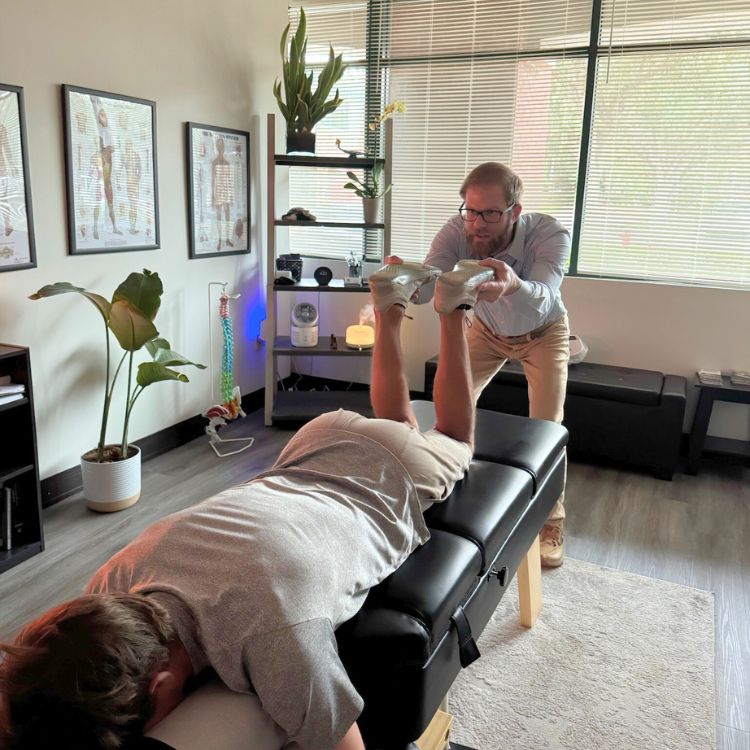
What Is Applied Kinesiology?
The combined terms “applied” and “kinesiology” describe the basis of this system, which is the use of manual muscle testing to evaluate body function through the dynamics of the musculoskeletal system. Treatments may involve specific joint manipulation or mobilization, various myofascial therapies, cranial techniques, meridian and Acupuncture skills, clinical nutrition, dietary management, counseling skills, evaluating environmental irritants and various reflex procedures.
Want to Learn More About Applied Kinesiology?
Click play below to watch a short documentary on Applied Kinesiology from the International College of Applied Kinesiology.
Does it hurt? No.
Muscle testing is exactly what it sounds like. Dr. Olenek applies light pressure to an arm, a leg, or another muscle group, and you hold against it. That is the whole test. There is nothing forceful about it, nothing invasive, and nothing that should be uncomfortable — and it is how the rest of the visit gets decided.
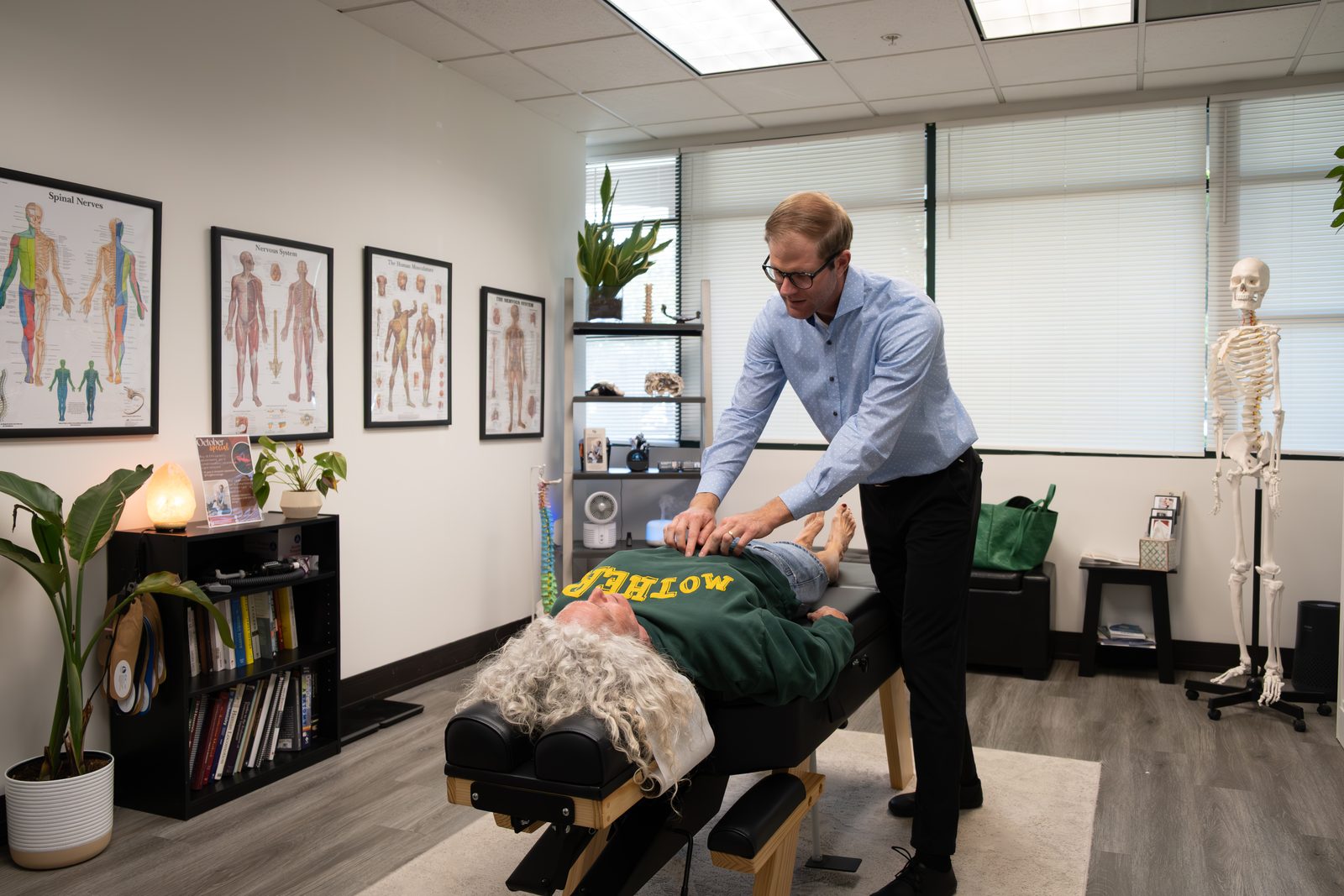
What follows is matched to you. Treatment may be a standard adjustment, or it may be soft-tissue work, cranial technique, acupressure, or low-force instrument adjusting with an Activator — a small spring-loaded tool that delivers a quick, light impulse with no twisting and no cracking. Dr. Olenek is trained in the Activator Method alongside Diversified, Thompson, McKenzie, and Sacro-Occipital Technique.
If a manual, hands-on adjustment is not something you want, say so at your first visit. There is a gentler route to the same work, and asking for it changes nothing about the quality of your care. More on gentle, low-force adjusting
The Lens Behind It
Applied Kinesiology gets described as muscle testing, which is accurate but incomplete. The muscle is not really the point — it is the readout.
What Dr. Olenek is assessing is how your nervous system is controlling that muscle right now. A muscle that responds one way under one condition and differently under another is information about function, not about the muscle itself. That is the same lens functional neurology uses: asking how the system is working, rather than looking only for structural damage or disease.
It is also why an AK visit can move from your shoulder to your diet to how you are breathing without that being a change of subject. The triad of health below is the same idea in its traditional form.
The honest limits. This is a framework for deciding where to look and what to try — not a diagnostic test. Research into manual muscle testing has not shown it to be a reliable way to diagnose disease, nutrient deficiency or allergy, and we neither use it that way nor ask you to take it that way. What it does is let Dr. Olenek work methodically from what your body is actually doing, and then check whether what he did changed it.
It is the same question CranioSacral Therapy asks with different hands.
Where X-ray fits. Muscle testing reads function, which is a different thing from structure. Full spine X-ray is part of the new patient examination for patients 13 and over, taken here in the office, and the findings are reviewed with you alongside everything the muscle testing showed. Children under 13 are not X-rayed.
The Triad of health
The triad of health lists the three basic causes of health problems. They are structural, chemical, and mental, with structure as the base of the triad. Literally, all health problems, whether functional or pathological, are involved with one part or all parts of the triad. This is not new to chiropractic, as its founder, D.D. Palmer states in his text The Science, Art, and Philosophy of Chiropractic, “The determining causes of disease are traumatism, poison, and autosuggestion.” AK enables the doctor to evaluate the triad’s functional balance and direct therapy toward the imbalanced side or sides. The physician who is aware of the triad of health, and evaluates every patient for all three sides, increases his ability to find the basic underlying cause of a patient’s health problem.
What Else Is Here, and Why People Combine It
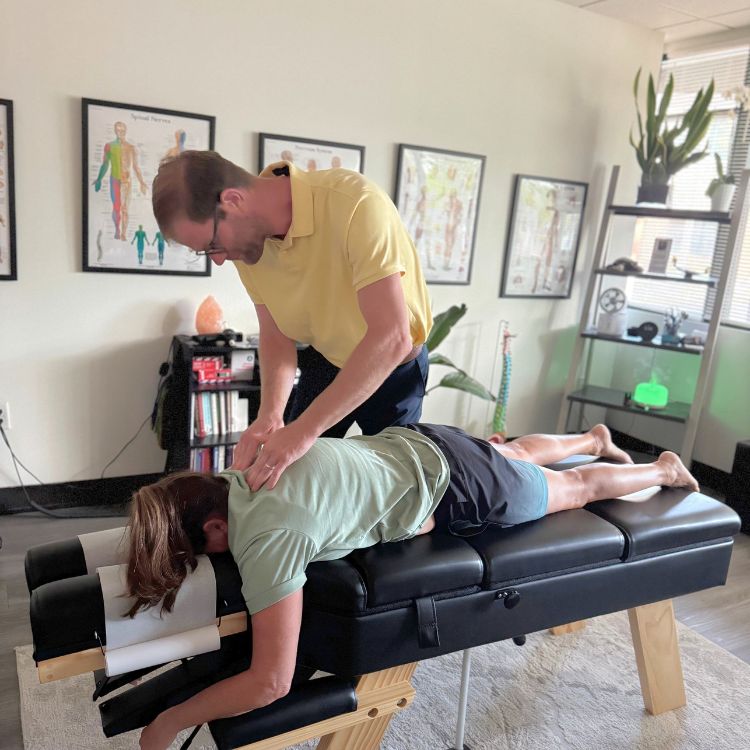
Most patients arrive for Applied Kinesiology because someone sent them. What surprises them is how much else is in the building.
Muscle testing is good at telling us where to look. Often the answer is somewhere a different tool reaches better:
- A joint that will not hold its correction — we look at the muscles around it, and often at NeuroKinetic Massage or Fire Cupping for the soft tissue holding it there.
- Tissue that is slow to heal — Hyperbaric Oxygen Therapy drives oxygen into places circulation struggles to reach, and Red Light Therapy works on the cell’s energy pathway.
- A nervous system stuck in overdrive — Acupuncture and CranioSacral Therapy both work on the autonomic side, from different directions.
- Something chemical — Chinese Herbal Therapy, Nutrition Counseling and vitamin or homeopathic injectables.
It is one team, one building, one conversation about you. Plenty of patients spend a morning here rather than driving to three addresses — adjustment, chamber, needles, in one visit. Ask at the front desk what would make sense to combine with what you are already doing.